
China's communist party has expelled two senior military officials, including General Zhang Youxia, the highest-ranking People's Liberation Army officer, for serious discipline and law violations.

Chinese President Xi Jinping is set to visit the United States from September 23 to 25 for summit talks with US President Donald Trump, with discussions expected to cover critical economic and trade issues, including AI, and the recently signed US sanctions law targeting countries buying Russian oil and gas.
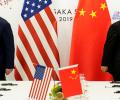
Top US and Chinese officials, including Vice Premier He Lifeng and Treasury Secretary Scott Bessent, held "candid, in-depth and constructive" talks in New York on economic and trade issues, with a specific focus on artificial intelligence. These discussions precede Chinese President Xi Jinping's anticipated visit to Washington and occur amidst new US sanctions targeting countries purchasing Russian oil and gas, and the US unveiling an "AI Force."

China has strongly rejected a US bill that would impose tariffs on countries, including India, for purchasing Russian oil and gas. Beijing views the "Lindsey O Graham Sanctioning Russia and Iran Act 2026" as an act of "long-arm jurisdiction" and interference in its sovereign trade relations, asserting that its economic cooperation with other nations is based on equality and mutual benefit.

China has called for stronger global governance of artificial intelligence, advocating for international cooperation to develop the technology for humanity's benefit while preventing it from getting out of control. This comes amidst warnings from leading AI researchers in the US about potential existential risks, with China emphasizing both rapid development and robust safeguards, including its new AI Safety Governance Framework 3.0. The issue is expected to be a key topic in upcoming US-China talks.

Chinese Foreign Minister Wang Yi stated that President Xi Jinping and Prime Minister Narendra Modi reached a crucial consensus during the BRICS summit, agreeing that China and India should be partners, not rivals. The leaders pledged to maintain peace and tranquility in border areas, deepen cooperation, and support each other in multilateral forums, aiming to strengthen the Global South and promote a multipolar world order.

China Southern Airlines is set to resume its Guangzhou-New Delhi passenger service from September 21, ending a six-year suspension. This move is part of a broader normalisation of India-China relations, following recent high-level diplomatic meetings and previous flight resumptions by other carriers.

Chinese President Xi Jinping is in New Delhi for the 18th BRICS Summit, where he is scheduled to hold bilateral talks with Prime Minister Narendra Modi. This visit, his first to India in nearly seven years, comes amidst efforts to normalise India-China relations following the 2020 Eastern Ladakh standoff and is expected to have significant implications for bilateral ties and BRICS cooperation.

China emphasises proper handling of differences and a long-term perspective for bilateral ties ahead of President Xi Jinping's visit to India for the BRICS summit and talks with Prime Minister Narendra Modi. The visit aims to stabilise relations following the 2020 Ladakh standoff and strengthen BRICS cooperation.

Chinese President Xi Jinping's upcoming visit to India for the BRICS summit is a pivotal diplomatic event poised to significantly impact bilateral ties and global cooperation amidst ongoing international instability.

A devastating fire on a foreign-flagged cargo ship undergoing repairs at the Qingdao Beihai shipyard in eastern China has resulted in 20 fatalities. Chinese President Xi Jinping and Premier Li Qiang have issued directives for intensified search and rescue operations, thorough investigations into the cause, and enhanced safety measures across all sectors to prevent future accidents.

India's Consul General in Shanghai, Pratik Mathur, extended greetings to Song Hou, Director General of China's Commercial Aircraft Corporation (COMAC), ahead of his visit to New Delhi for the BRICS Business Forum 2026. Discussions focused on B2B, technology, and connectivity ties, aligning with India's BRICS Presidency vision. The forum precedes the 18th BRICS Summit.

Chinese officials warn that glaciers on the Tibetan Plateau are becoming increasingly unstable, leading to a higher risk of flash floods and other disasters, as evidenced by a recent deadly ice-rock avalanche near the Nepal-Tibet border. The region has seen a significant reduction in glacier area, and scientists are calling for advanced monitoring systems to predict these complex events.

China on Monday dismissed claims linking its massive hydropower projects in Tibet to the August 26 flash flood disaster in Nepal, calling them "malicious speculation".

A Chinese military trading company executive has been arrested for allegedly leaking sensitive defence information to intelligence agencies from two countries, China's top spy and anti-espionage agency said on Monday.

China on Friday said the collapse of a high-altitude glacier in Nepal may have triggered the massive flash flood disaster that engulfed the Tibet-Nepal border, killing hundreds and causing widespread damage.

Flash floods in Tibet's Gyirong County, near the China-Nepal border, have resulted in five deaths and 558 missing individuals, including 260 foreign nationals. The disaster also caused significant casualties in Nepal and disrupted infrastructure. Rescue operations are underway, and concerns are rising over a newly formed barrier lake that poses a risk of further flooding.

Devastating flash floods near the Tibet-Nepal border have led to the evacuation of over 1,000 people, including tourists, from Gyirong County. The floods caused casualties in both Tibet and Nepal, disrupted infrastructure, and prompted a Level-IV alert due to a rapidly forming barrier lake with a high risk of breaching and causing further downstream flooding.

China has issued a Level-IV alert due to a newly formed barrier lake at the Tibet-Nepal border, warning of a high risk of breaching and flooding downstream areas. The lake, formed at the confluence of Chhochen Khola and Purepu Tsangpo rivers, has accumulated an estimated two million cubic metres of water, with inflows expected to increase, raising concerns for areas including Gyirong Port.

A massive flash flood near the China-Nepal border in Tibet has left hundreds missing and caused significant casualties. Chinese Premier Li Qiang visited the affected Gyirong Township to oversee rescue and relief operations, with the PLA mobilising forces for search and rescue.
